
Robotic Surgery in Modern Medicine
Robotic-assisted surgery has evolved from an experimental concept into a widely adopted clinical technology. Since the first robot-assisted neurosurgical procedure in the mid-1980s, advances in imaging, computing power, motion control, and miniaturized electromechanical systems have transformed surgical robotics into a critical tool for modern healthcare.
Today’s robotic surgical platforms assist physicians in performing complex procedures through minimally invasive techniques that improve surgical precision while reducing trauma to surrounding tissue. These systems are now used across numerous specialties, including urology, gynecology, cardiothoracic surgery, colorectal surgery, and general surgery.
The growth of robotic surgery has been driven by improvements in:
- High-resolution medical imaging
- Micro-scale actuators and precision motors
- Advanced control software and kinematics algorithms
- Sensor-based force and motion feedback
- Miniaturized endoscopic instruments
Together, these technologies enable surgeons to operate with levels of accuracy and stability that exceed the natural capabilities of the human hand.
Early Development of Surgical Robotics
One of the earliest demonstrations of robotic surgery occurred in 1985, when an industrial robotic arm was adapted to guide a needle during a stereotactic brain biopsy. This pioneering work helped establish the feasibility of robot-assisted medical procedures.
Subsequent developments led to the introduction of specialized medical robotic platforms. The Neuromate system, approved by the U.S. FDA in 1999, was designed for stereotactic neurosurgery. Using preoperative CT or MRI imaging, the system assists surgeons in navigating precise pathways through the brain to reach tumors or other targets while minimizing damage to surrounding tissue.
Another early system, Robodoc, introduced in the early 1990s, assisted surgeons during orthopedic procedures such as hip replacement. The robotic platform helped prepare the femoral cavity with high precision before placement of a prosthetic implant.
These early systems laid the groundwork for modern robotic surgical platforms that support increasingly sophisticated procedures.
Minimally Invasive Robotic Surgery
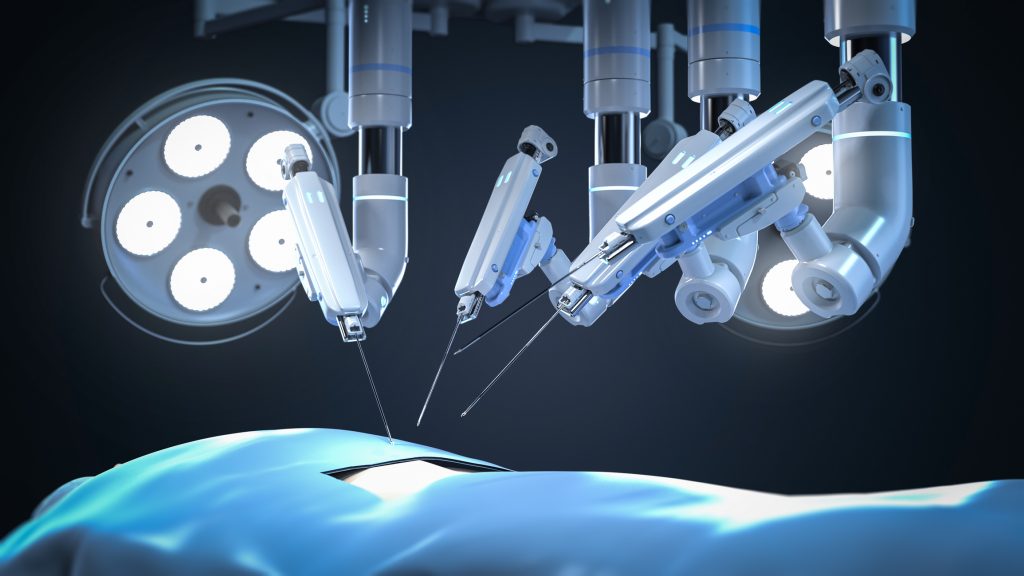
Today, robotic systems are most commonly used in minimally invasive surgery, where operations are performed through small incisions using specialized instruments and imaging systems.
During a typical robotic-assisted procedure:
- Small incisions are made in the patient.
- Narrow tubes, known as ports, are inserted to access the surgical site.
- A high-definition endoscopic camera and miniature surgical instruments are introduced through the ports.
- The surgeon controls robotic instruments using a console that translates hand movements into highly precise tool motions.
Modern systems provide three-dimensional, high-definition visualization of the surgical field, allowing surgeons to view internal anatomy with exceptional clarity.
Robotic instruments can also articulate in ways that traditional laparoscopic tools cannot, providing additional degrees of freedom for complex surgical maneuvers.
Precision Motion and Dexterity
One of the most significant advantages of surgical robotics is the precision provided by miniature actuators and high-performance control systems.
Robotic surgical instruments are driven by compact servo motors and linear actuators capable of extremely fine motion control. These motors are typically paired with integrated encoders, gear systems, and high-speed control electronics that allow surgeons to manipulate instruments with sub-millimeter precision.
Advanced motion control software translates the surgeon’s hand movements at the control console into scaled instrument movements inside the patient. This scaling allows large hand motions to produce very small, highly controlled tool movements.
Modern systems may provide multiple degrees of freedom, enabling robotic instruments to replicate and extend the natural motion of the human wrist while operating in confined surgical spaces.
Haptic Feedback and Sensor Integration
A critical component of modern surgical robotics is the integration of sensors that provide real-time feedback to the surgeon.
In early robotic systems, surgeons had limited ability to sense how much force they were applying to tissue. Today’s systems incorporate multiple sensing technologies, including:
- Force and torque sensors
- Strain gauges
- Position encoders
- Motion tracking systems
These sensors feed data to the robotic control system, allowing surgeons to better judge the amount of pressure applied during delicate tasks such as suturing or tissue manipulation.
Although fully immersive tactile feedback remains an area of ongoing research, sensor-based force monitoring has significantly improved surgeon control and patient safety.
Endoscopic Systems and Instrument Delivery
Another essential component of robotic surgery systems is the delivery platform used to introduce cameras and surgical tools into the body.
Endoscopic assemblies typically include:
- High-intensity LED illumination
- Miniature cameras
- Thin-wall catheter shafts
- Reinforced tubing structures
- Articulating surgical instruments
These systems must balance flexibility, strength, and precise control while navigating delicate anatomical pathways.
Advanced catheter and tubing technologies—including reinforced braid structures and fluoropolymer-lined shafts—enable precise positioning of cameras and tools while maintaining durability during repeated use.
Electrical Interconnect Systems
While surgical robots are often recognized for their imaging and mechanical systems, their electrical infrastructure is equally critical.
A robotic surgical platform relies on complex networks of electrical cables and interconnect systems to transmit power and signals between motors, sensors, cameras, and control electronics.
These interconnect systems must support:
- High-speed digital data transmission
- Analog sensor signals
- Motor power delivery
- Electromagnetic compatibility
- Precise signal timing
Specialized cable designs, including coaxial cables and twisted-pair configurations, are used to maintain signal integrity while meeting strict requirements for impedance, attenuation, and signal skew.
Reliable cabling and interconnect systems are essential for maintaining the accuracy and responsiveness required during robotic surgical procedures.
The Future of Robotic Surgery
Robotic surgical systems continue to evolve rapidly as new technologies emerge. Advances in artificial intelligence, machine vision, and real-time data analytics are expected to further enhance robotic surgical capabilities.
Future systems may incorporate:
- AI-assisted surgical guidance
- Enhanced haptic feedback technologies
- Greater autonomy for certain repetitive surgical tasks
- Improved imaging integration and surgical navigation
As these innovations mature, robotic systems will continue to expand their role in modern medicine, enabling surgeons to perform increasingly complex procedures with greater precision and improved patient outcomes.